
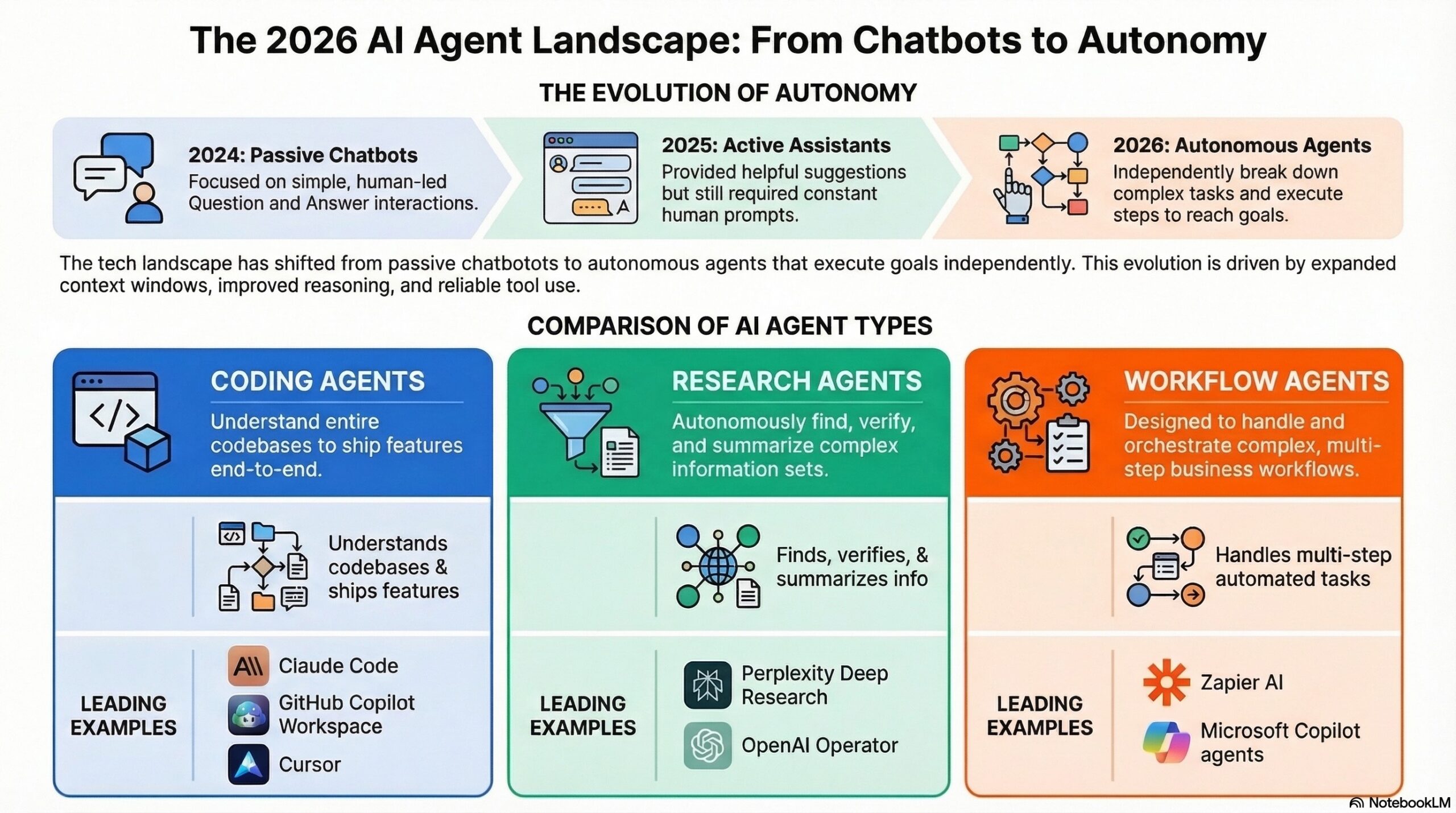
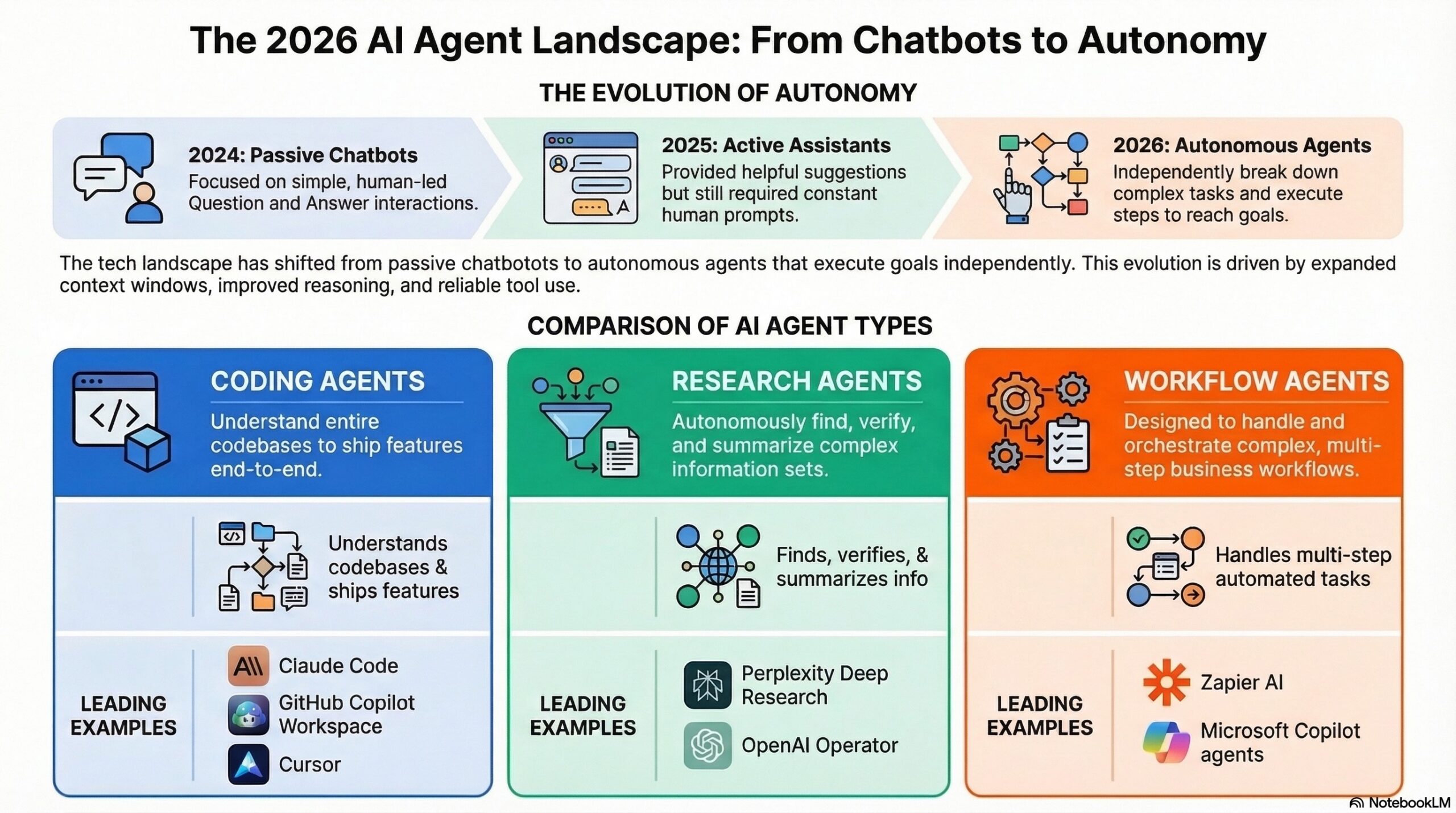
The conversation around AI has shifted. In 2024, everyone talked about chatbots. In 2025, it was AI assistants. Now in 2026, the word on every tech conference agenda and every startup pitch deck is “AI agents.”
This isn’t just another buzzword cycle. Something actually changed.
What Changed
Autonomy.
Last year’s AI tools waited for you. You asked a question, you got an answer. You gave a prompt, you received output. Useful, but passive.
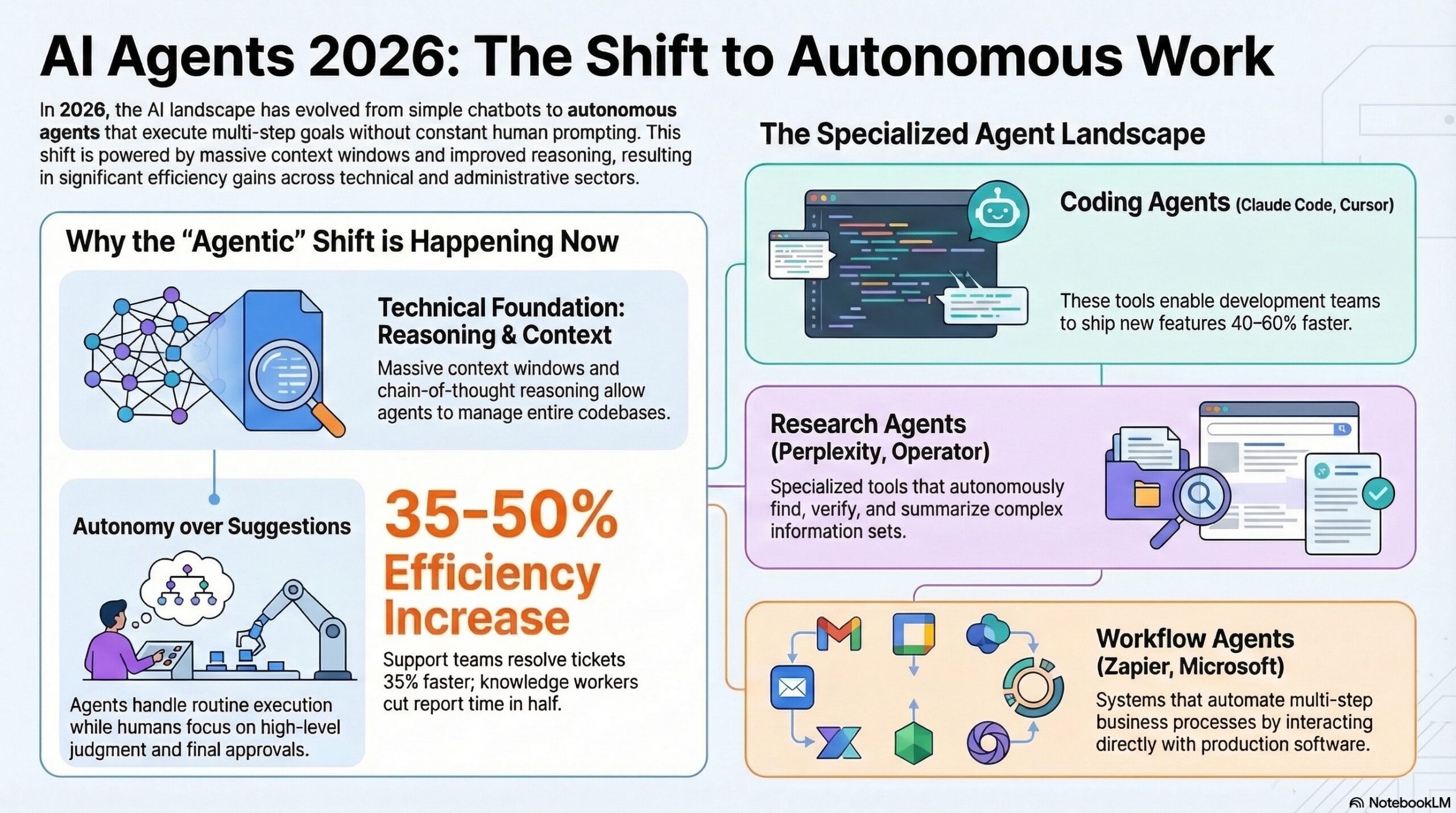
AI agents don’t wait. They take a goal and run with it. They break down complex tasks, execute steps, adapt when things break, and hand you finished work instead of suggestions.
Claude Code, released by Anthropic in late 2025, showed what this means in practice. You don’t type “write me a function.” You say “build a REST API for user authentication.” It creates the files, writes the code, sets up tests, and fixes the bugs it finds. The first time I watched it happen, I called it magic. Six months later, it feels normal.
That normalization is the story of 2026.
Three Types of Agents (Because There Are Actually Three)
The market sorted itself into categories pretty fast:
Coding agents. Claude Code, GitHub Copilot Workspace, Cursor’s agent mode. These don’t autocomplete code. They understand entire codebases, make architectural calls, and ship features end-to-end. A developer at a mid-sized startup tweeted that their team shipped something in two days that would’ve taken two weeks. Same team size. Same people. Just faster.
The junior dev impact is weird. Tasks that used to need senior oversight, setting up auth, configuring databases, writing deployment scripts, can now go to agents. Seniors review output instead of writing from scratch. Whether this is good or bad for junior development remains genuinely unclear to me.
Research agents. Perplexity’s Deep Research, OpenAI’s Operator, others. You don’t search for information anymore. You assign an agent to find, verify, and summarize it. For technical writing and competitive analysis, these have become hard to live without.
Workflow agents. The fastest-growing category. Zapier’s AI agents, Microsoft’s Copilot agents, dozens of startups. They handle multi-step workflows: processing invoices, scheduling meetings, coordinating between tools. They don’t suggest what you should do. They do it.
Why Now
Three things converged in late 2025:
Context windows got huge. Models can now hold entire codebases and long documents in memory. An agent building a feature needs to understand how it fits with existing code. Previous models forgot critical context after a few thousand tokens. Current models maintain coherent understanding across hundreds of thousands. This matters more than people realize.
Reasoning improved. Chain-of-thought moved from research to production. Agents work through problems step by step now, catching errors before they cascade.
Tool use became reliable. The ability to execute commands, call APIs, and write files moved from experimental to trustworthy. Agents can interact with production systems without constant human supervision.
The Enterprise Thing
Companies that banned AI tools in 2024 are racing to adopt agents now. ROI became undeniable.
A McKinsey study from January 2026 found teams using coding agents shipped features 40-60% faster. Customer support teams using workflow agents resolved tickets 35% faster. Knowledge workers produced reports in half the time.
The security concerns that dominated 2024 conversations have mostly been addressed. Enterprise agents run on approved infrastructure now, with audit logs and access controls.
What’s Coming
Multi-agent systems. Instead of one agent doing everything, specialized agents collaborate. A coding agent works with a testing agent and a deployment agent, each handling its domain.
Agent-to-agent communication. Agents from different platforms starting to interoperate. Your coding agent delegates research tasks to a specialized research agent, passes results to a documentation agent.
More autonomy. Current agents still need human check-ins. The goal for late 2026 is “set and forget” mode, agents that run for days or weeks, handling routine work and escalating only genuine edge cases.
The Human Role
The “AI will replace jobs” anxiety has played out differently than people expected. Agents don’t replace humans. They change what humans do.
Senior engineers spend less time on boilerplate, more time on architecture. Writers spend less time on research, more time on original thinking. Managers spend less time on coordination, more time on strategy.
Agents handle routine. Humans handle judgment calls. That pattern has held across every industry adopting agents.
Getting Started
For individuals, the barrier is low. Claude Code has a free tier. GitHub Copilot Workspace comes with GitHub subscriptions. The tools are accessible.
For organizations, it’s more complex. Identify high-volume repetitive tasks. Start with a pilot team. Measure results. Build internal docs. Expand gradually.
The companies that started in late 2025 are seeing compound returns. The ones that waited are scrambling.
The Actual Bottom Line
AI agents in 2026 aren’t experimental. They’re production tools that ship.
The shift from chatbots to agents isn’t about a new product category. It’s about AI that works for you instead of AI you work with.
If you haven’t integrated agents into your workflow, you’re not late. But you’re not early either. The technology exists. The ROI is real. The adoption curve is steep.
Sources: